
How Civic Language Unites, Divides, & Motivates American Voters
How to Talk Bridgey 2.0 translates fresh 2025 national data into practical guidance for communicating about democracy, civic life, and perceived threats in a precarious moment. Drawing on research with Americans across differences, this updated guide shows how language can either keep people engaged or quietly push them away and offers concrete lessons for choosing words that invite connection rather than close it off.
How to Talk Bridgey 2.0 is a practical, data-informed resource for funders, practitioners, communicators, and civic leaders who want to engage broad audiences without flattening values or forcing false unity.
• It is about using language strategically to sustain connection
• It is not a list of “good” or “bad” words
• It is grounded in how Americans actually perceive civic language today
• It is not prescriptive about what you must say or fund
Talking bridgey is a skill, one that helps keep conversations open when stakes are high.
What’s New in Version 2.0
This update reflects a new national survey conducted in November 2025 with More in Common, allowing PACE to examine how civic language is changing over time and what that means for practice today.
New in 2.0:
• Fresh 2025 data on how Americans perceive civic and democratic terms
• A clearer, more direct measure of bridgeyness
• Evidence that many core civic terms are becoming more bridgey, not less
• New insights on how Americans prefer to talk about democracy and threats to it
• Expanded guidance on civic activation and engagement
Who This Guide Is For
• Funders shaping strategy and grantmaking
• Civic and democracy practitioners
• Communications and messaging professionals
• Researchers, journalists, and educators
• Anyone navigating high-stakes conversations about democracy
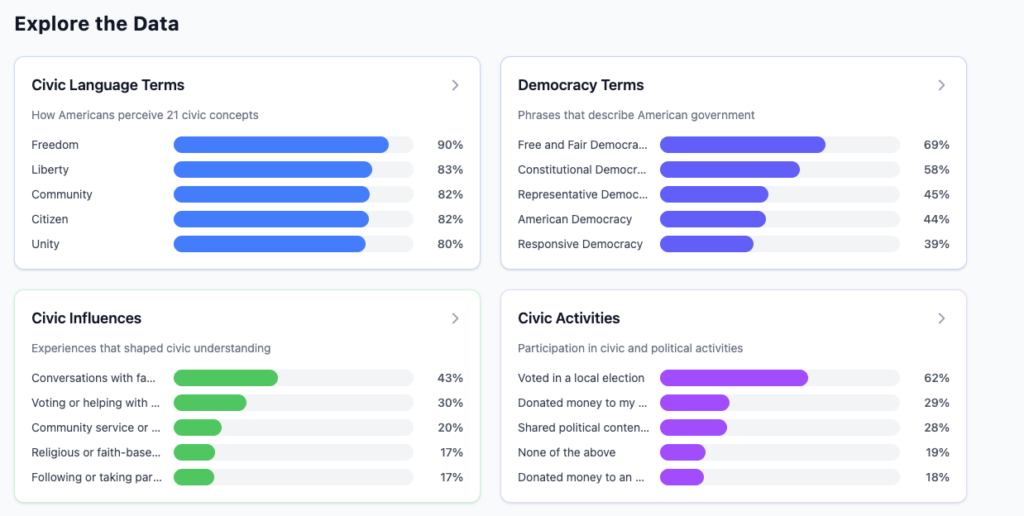
PACE’s Civic Language Perceptions Project is an ongoing national research effort examining how Americans across differences understand civic and democratic language. Since 2019, the project has combined quantitative and qualitative research to help the civic field communicate more effectively.
Help spread the word about PACE’s new How to Talk Bridgey 2.0 guide using our communications toolkit with sample newsletter language, social media drafts, and graphics.
At a time when Americans are deeply divided, the words we choose matter more than ever. PACE’s Civic Language Perceptions Project (CLPP) is one of the largest and most rigorous efforts to understand how everyday civic language is heard across differences and how it can either build connection or shut it down.
Through nationally representative research with thousands of voters, CLPP reveals a simple but powerful truth: language shapes whether people feel invited into civic engagement or pushed away from it.
What We’ve Learned
CLPP helps leaders move beyond instinct and assumption, offering clear, evidence-based guidance on how to communicate in ways that resonate with a broader cross-section of Americans.
• Some civic terms bring people together and others divide. Words carry signals about identity, belonging, and political alignment, often in ways we don’t intend.
• “Talking bridgey” expands reach without weakening values. It’s not about watering down beliefs; it’s about expressing them in ways more people can hear and engage with.
• Language can help build a bigger, more durable pro-democracy majority. Leaders who understand how words land across audiences can communicate with greater clarity, trust, and impact.
Why It Matters Now
Most Americans value freedom, fairness, and the ability to have a voice in shaping their future. But many struggle to connect those values to the systems and institutions that make them possible. At the same time, polarization and mistrust are making it harder to have productive conversations about our shared future. CLPP equips civic leaders, funders, and communicators to meet this moment by using language that:
• reinforces shared American identity
• connects democracy to everyday life
• invites participation instead of triggering division
• strengthens trust in democratic principles and institutions
From Research to Practice
CLPP is not just research, it’s a practical tool for action.
PACE translates these insights into accessible guidance, tools, and field-wide learning so leaders can:
• communicate across lines of difference
• expand their audience without losing clarity or conviction
• strengthen civic engagement and democratic participation
This work is already being applied by funders, advocates, and organizations across the country to build broader coalitions and more effective pro-democracy messaging. PACE believes American democracy is an ongoing experiment, one that depends on people working together across differences to solve problems and shape our shared future. CLPP helps make that possible by giving leaders a clearer understanding of how to speak to the country as it is and invite more people into the work of strengthening it.
Explore the Research
Dive deeper into the Civic Language Perceptions Project and learn how to apply these insights in your work:
→ pacefunders.org/language
→ civiclanguage.org
→ prodemocracynarrativeplaybook.org
Learn more about the methodology used for the Civic Language Perceptions Project, including sampling, weighting, and survey design, and receive guidance for engaging with the research findings or publishing related content.

See the wording, format, and order of questions we asked participants.

Explore the 2023 findings, learn more about the history of the Civic Language Perceptions Project, and explore the “How to Talk Bridgey 1.0” guide.
Have a question that this page can’t answer? Email our team, who will reply within 24-48 hours.
PACE is grateful for the support of the partners that made this project and resource possible: the McKnight Foundation in 2023 and 2025, and the Rita Allen Foundation, Lumina Foundation, and the Ronald Reagan Presidential Foundation in 2023.
The lead author of the original How to Talk Bridgey resource is Amy McIsaac, Managing Director at PACE. This 2.0 version was created by Siri Erickson, Senior Director for Strategy and Learning at PACE, with guidance and support from Aly Ferguson, Amy McIsaac, and Shannon N. Green. Survey design and data analysis was led by Freg Duong, Senior Research Manager at More in Common. Graphic design was provided by Cameron Blossom.
PACE thanks all organizations who contributed to the analysis phase of the Civic Language Perceptions Project, especially our research partners at More in Common.